

Summer Slide Is Real: How Schools and Communities Can Prevent Learning Loss
- May 6
- 3 min read
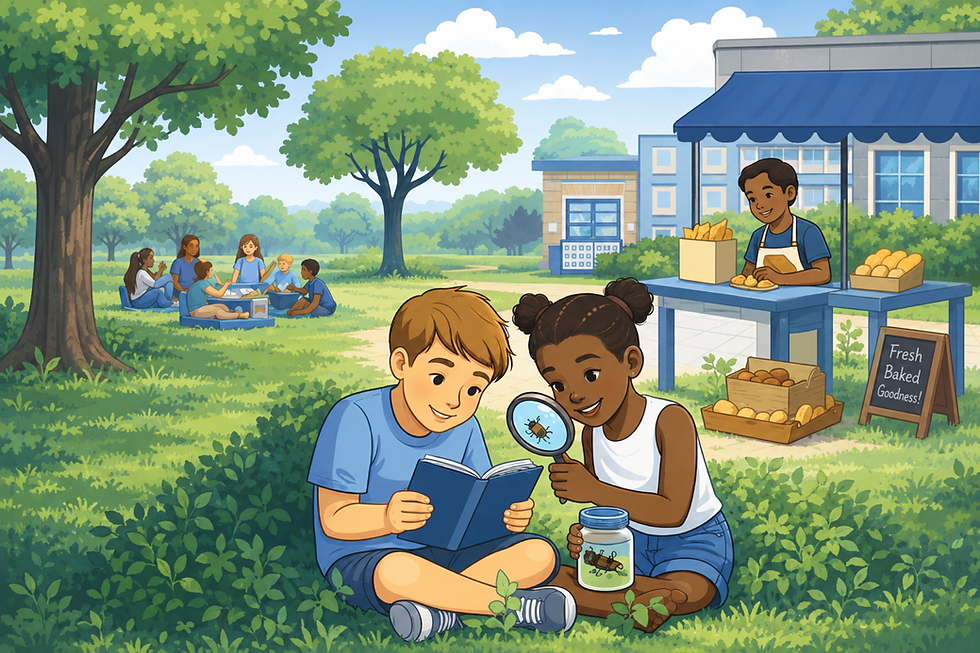
Summer is just around the corner, and our classrooms are about to get much quieter.
Summer break, a long-cherished period of rest and relaxation, remains surprisingly controversial in the United States.
Some view summer break as an agrarian relic, unnecessary in a world where child labor laws keep children out of orchards and fields. Others see it as a necessary pressure release valve that prevents burnout for students and staff. Some large districts, such as Los Angeles Unified School District, experimented with year-round schooling before changing course. Others, like KIPP, extend the school day and year while maintaining a traditional summer break.
I am not here to tell you what your academic calendar should look like. That decision belongs at the local level, where school boards can work directly with families to design calendars that meet community needs. Rural and urban districts face different realities. Regions prone to hurricanes require flexibility that looks very different from snow-day planning in northern states.
What I will say is this: summer break inevitably creates a summer slide.
Why Summer Slide Matters
Have you ever tried to recall the details of a meeting agenda weeks after it happened? Now imagine ten weeks later. Ten weeks, the typical length of an American summer break, is plenty of time to forget foundational literacy and numeracy skills.
Data from across the United States shows that students often regress in math and reading over the summer, and the longer the break, the greater the regression. This matters because students may need to be re-taught skills they previously mastered, costing valuable instructional time in the fall.
The relationship is clear: more time out of school leads to more learning loss.
We may be talking about summer slide in 2026, but in 2020 we faced a COVID learning chasm, when some schools remained closed for four, five, or even six months. That disruption highlighted just how quickly learning loss can accumulate.
What Can Education Organizations Do?
1. Acknowledge and Plan for Summer Slide
Awareness is the first step. When leaders anticipate learning loss, they can plan targeted supports instead of reacting in the fall.
2. Partner With the Community to Support Summer Learning
Community partnerships can keep students engaged even when school is out. Consider:
Connecting families to affordable or free summer camps
Partnering with libraries to promote summer reading programs
Distributing take-home learning kits through nonprofit partners
Supporting teen volunteer opportunities and summer jobs
Even short-term employment helps students build life skills, confidence, and professional connections.
3. Strengthen Summer Programming
Many districts already provide summer meals. Could you expand partnerships to include access to enriching experiences such as museums, zoos, or science centers?
Some districts are reimagining summer school as summer camp, blending academics with field trips, life skills, and time for fun.
Education writer Tim Daly has shared compelling ideas on making summers more enriching for families. One standout example is Every Kid Outdoors, which provides free fourth-grade passes to national parks and landmarks.
4. Equip Families With Screen-Free Learning Ideas
Families will spend more time together over the summer, and many are eager to reduce screen time. Schools can help by sharing:
Screen-free games that reinforce learning
Local family-friendly events
Free community resources
Some families have vacations and camps planned, but many do not. That does not mean summer must become endless reruns of cartoons. Local resources can create meaningful, low-cost learning experiences.
Last summer, our local library system hosted a challenge inviting families to visit all 15 branches and collect stamps at each location. Participants could complete the challenge in a day or spread it across the summer. My family visited every branch in one weekend, checked out more than 70 children’s books, collected seeds to plant lettuce, and even brought home a stuffed bear that is still cherished today.
It was free, local, and deeply educational. We learned more about beetles than I ever expected. Experiences like these show that meaningful summer learning does not have to be expensive or complicated.
Final Thoughts
How are you preparing families for the summer slide? What strategies are you using to address learning loss before it becomes a fall crisis? Join the conversation on social media and share the strategies your system is using for summer.
About Instructional Data Solutions: Our mission is to remove barriers to enable education organizations to focus on what matters most. We assist school systems and education organizations of all sizes by collecting, analyzing, and clearly communicating data. We are committed to empowering educators through comprehensive data analytics and tailored support. Additionally, we provide dedicated support for operational needs, process improvement, and special projects, offering customized solutions to enhance effectiveness and success. Our solutions bridge the gap between data collection and instructional improvement in PK-12 settings.


Comments