

Can AI Help Teachers Make Better Data Decisions? What the Research Says
- 4 days ago
- 3 min read
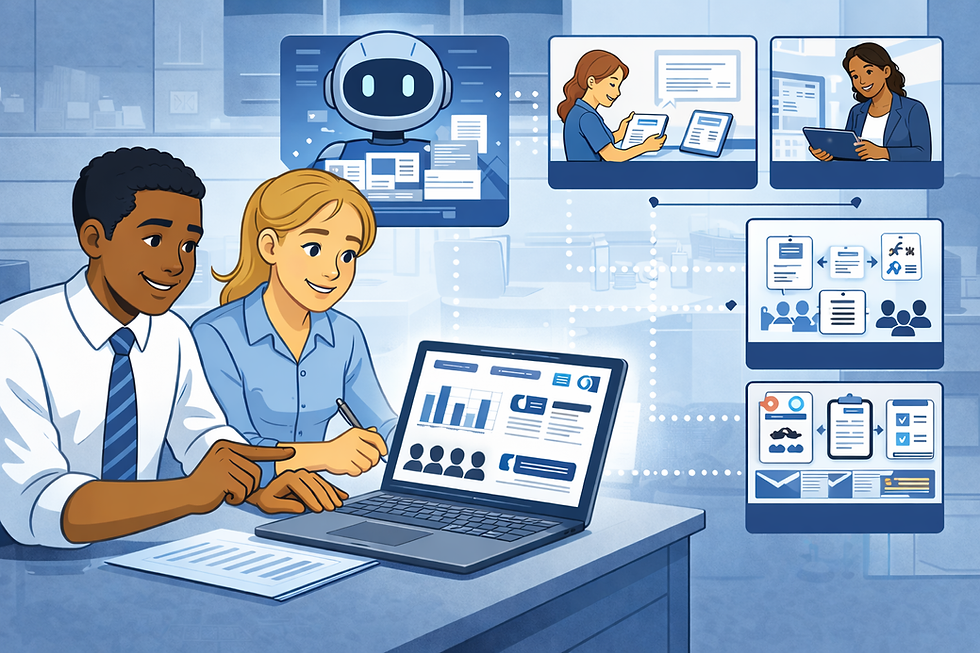
AI seems to be getting more and more pervasive in education.
From the buzz about AI-taught “Alpha School” organizations to new tools that support literacy with AI-enabled responses to kids reading, we are seeing a flourishing of AI tutors being harnessed to support learning. Is this working or are just one more EdTech bubble?
AI Productivity Overblown?
On the one hand I’m a bit skeptical of the next AI trick. I’m really getting sick of those AI-generated posts on LinkedIn (short, punchy sentences! Gratuitous em dashes! Plethoras of overly twee emojis!). And we are all rightly nervous about the AI slop coming in online videos and YouTube shorts. Post-pandemic, I’m seeing a huge return to in-person events and demand for the truly human element to educational offerings. None of that feels like AI is helping. Honestly, the transformational AI bit is feeling oversold; I’m sympathetic to the arguments from thinkers like Dr. Newport that AI progress is stalling out and that maybe flying cars and robot butlers aren’t coming in the next year or maybe even the next decade.
Where does AI make a real difference?
That’s not to say there’s AI malaise everywhere. But where is AI really working? Research across a variety of sectors shows AI productivity gains are anywhere between 10-80% (turns out this stuff is super hard to measure!) and it is most useful for tasks that are
Routine and repeatable
Rules-based with clear success criteria
Time-consuming but low in professional judgment
So, how does that impact the field of education?
AI’s Best Role in Education: Reducing Routine Work
Education isn’t quite analogous to an assembly line and the technology-centric fields where AI productivity gains have been best studied. Teaching a child to read and reading a telemarketing script are pretty different. Where AI can best support teachers is by removing or simplifying the routine tasks, freeing up instructor time for the more human and personal aspect of things.
Example 1: Reduce the burden in Assessments
This can look like Daisy Christadoulou’s work using AI for grading. She started with having teachers read their remarks aloud as they reviewed student essays, and had the AI transcribe the feedback so that teachers could give more feedback more quickly. AI doesn’t have to replace a teacher reviewing and providing feedback; it’s often most helpful when it augments the human element to make feedback simpler to provide.
Example 2: Make Data Entry Simple
AI in education can also look like utilizing scripts and time-saving options for data entry. I know I’ve personally saved hours of time by using photo artifacts. The AI is able to enter data into a spreadsheet and store the data quickly and cleanly. I really like Ethan Mollick’s work here on the “human in the loop” and working in tandem with AIs to make routine work more efficient, while preserving the essential nature of the human person doing the work.
Example 3: Streamline Data Analysis
The last step after grading and data entry is data analysis and AI can really shine here! Here at Instructional Data Solutions, we’ve created the Cohort Achievement Tracker AI Insight for RTI (Response to Intervention). The AI Insights feature securely analyzes student data, such as DIBELS subscores, and then gives you research-based recommendations for next steps. You can
Generate recommended intervention groups based on specific needs (e.g., Phonological Awareness deficits identified in DIBELS) to populate your small groups, while getting clarity on why students B and C are grouped together
Suggest evidence-based intervention strategies tailored to each group's needs and get direct hyperlinks to publicly available interventions aligned to the Science of Reading
Propose detailed implementation plans (frequency, duration, and specific activities/resources)
This tool is a great use of AI because it takes what could be a very tedious task (gathering the data, analyzing the data, and researching resources) and making it as simple as the click of a button. This is most helpful for teachers who are time-strapped. By using AI to automate the routine parts, teachers can get back to teaching!
Final Thoughts and How to Take Action
Have you utilized AI for educational purpose? We’re all ears and invite you to join in the conversation on social media. And if you are ready to transform how your school uses AI to support student learning, we invite you to grab time with us to talk more!
About Instructional Data Solutions: Our mission is to remove barriers to enable education organizations to focus on what matters most. We assist school systems and education organizations of all sizes by collecting, analyzing, and clearly communicating data. We are committed to empowering educators through comprehensive data analytics and tailored support. Additionally, we provide dedicated support for operational needs, process improvement, and special projects, offering customized solutions to enhance effectiveness and success. Our solutions bridge the gap between data collection and instructional improvement in PK-12 settings.



Comments